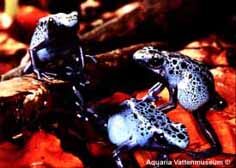
Poison arrow frogs live in the humid rainforests of Central and South America. They secrete poison from the pores of their skin – the strenght of the poison varies between different species. The most toxic variety can easily kill a human being – just touching a leaf where a frog has been sitting can be lethal. South American indians dip the darts of their blowpipes into poison they gather from these frogs.
Their strong, contrasting colours serve as a warning to predators: ”I’m poisonous – don’t eat me!”.
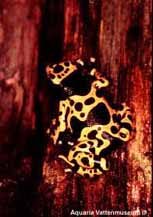
Another interesting characteristic is their parental care, which they do not share with many other frogs. Poison arrow frogs mate and lay about ten eggs on, for example, a leaf. Ten days later the eggs are hatched. The male (in certain species, the female) lifts the tadpoles onto his back and sets off to find suitable nurseries, sometimes as high as 40 m up in the treetops. Bromelia plants are ideal, since their vaselike form serves as a store for rainwater.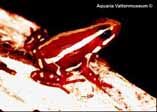 One tadpole is placed in each pool, since the young frogs are cannibals. The females of certain species regularly visit their young, feeding them with unfertilised eggs. In other species, the male lures other females into laying eggs in the nurseries, as food for his offspring.
The largest poison arrow frog can grow to around 7 cm, while the smallest are no larger than 1,5 cm.

Uppdated 980225 Webmaster